Saturday, March 16, 2013

Excellent Exeter

Well, it seems that rain has ruined my planned day trip to Exmouth and its beaches (but I shall get there soon), luckily for my readers I'm not the type of person to give up. As such, today I happy to present my latest blog post on the wonderful location of... the University of Exeter. Yeah, it's not exactly as exotic or interesting as London or the Loch Ness (which I'll be visiting in two weeks, get excited), but it's where I've spent these past 2 and half months, so I figured it was due for a blog post.
To start, the university is actually fairly young, being formally chartered in 1955 (although precussor institutions have existed since mid 1860s). The school has three main locations: Streatham Campus,
 St. Luke's Campus, and Cornwall Campus. I'm based in Streatham Campus, so that will be the focus of today's post.
For starters here is the dorm complex where I live.

Nice right? The complex is brand new and feels extremely modern, well, at least for most of the buildings. Some are actually quite old. Here's where I live...

Not quite at nice, but still nicer than the Units. As to its age, some graffiti outside my door indicates that these older buildings been here since the late 1980s.  As it is, its quite pleasant, albeit simple, on the inside, and as with any dorm the experience comes down to the people rather than the place, and I'm fortunate to be living with some pretty awesome people.

Moving onto the rest of the campus, the centerpiece is the Forum, which was completed only last year. As you can see it's pretty impressive...


The building is massive, and includes the library, a grocery store, a bar, two restraints, a study hall, a large lecture theatre, a few coffee shops, and several classrooms. It's the heart of the campus, and several other buildings, such as the Northcote Theatre, where you can see many great performances. (In the picture below its building towards the back, next to the street)
Moving on, one of the principle academic buildings is the Amory. It's here where I have to hand in most of my assignments and it also contains a computer lab and many office and classrooms. As you can imagine, it's a gigantic building, but luckily it has a very well-designed map system.
Most of my classes take place in the building right behind the Amory, the Harrison Building, but I also have a class in the Institute for Arabic and Islamic Studies. From the outside the building is rather unassuming...

But the inside is probably the best example of interior design on campus after the Forum.
(Photo Credit, University of Exeter Web Page)
The building was sponsored by the ruler of  Sharjah in the UAE, who, like me, is a avid lover of history.  Maybe one day I'll have enough money to sponsor a academic building (probably not).
 

I also have class in the Peter Chalk Center. Not much to say about the building, but it serves its purpose.
Like William and Mary, the campus has quite a lot of green space in it (although no forest or lake sadly), which creates a pleasant, and almost futuristic environment, when paired with the modern buildings.


In addition, it also has quite a lot of hills, which provide some great views, while also giving one a decent workout as one walks to class.


So that's the University of Exeter. I'll probably do another one of these posts in a couple of weeks to show some of the buildings I didn't get a chance to photograph. In the meantime, I'm happy to announce I'm starting a second blog. Yes, I've enjoyed this blog so much that I wanted to create a new project to keep me occupied once my semester abroad is over. Titled 'Hobbes and Joffrey: Politics Explained with Pop Culture' it attempts to examine how political theories and concepts are demonstrated or influence popular books, TV shows, and movies. The first post, which looks at how the theories of Thomas Hobbes relate to Game of Thrones, has already been posted and I'd appreciate it if you could all give it a look at http://politicspopculture.blogspot.co.uk/. 
In other news, I've very excited for the next few weeks worth of posts on this blog. Next week I'll be taking a weekend trip to Liverpool, the place where the Beetles got their start and millions of immigrants headed off to the New World. In the beginning of April, I'll be taking a two week train and bus trip around the UK, from London to Inverness and then back to Exeter.  It's going to be a fun time, and you're not going to want to miss it.

Tuesday, March 5, 2013

The Royal Albert Memorial Museum

A few weeks ago, I visited the Royal Albert Museum in Exeter. As you probably guessed the museum was named after this fellow...
Prince Prince Albert of Saxe-Coburg and Gotha was the consort to Queen Victoria, who ruled England during in which the monarchy lost power, but the British Empire dominated the globe. Albert, an avid supporter of learning, hosting the Great Exhibition in London to raise awareness about about the wonderful achievements of all nations, but mostly Britain. When he died, Victoria blamed her son for her husband;s death, saying that he had stressed him to the point of collapse (Victoria and her kids didn't really get along). She then went into mourning for the next decade and she wore black until she died. Others had more constructive ways to deal with his passing. Sir Stafford Northcote of Pynes decided to found a museum in his former employers' honor, and thus the museum was born.

The Museum, like the Great Exhibition, contains artifacts from all over the world, but mostly Britian. From Asia we have this lovely Buddist statue...
As well as this full samurai armor...
There's a reason the samurai were feared and respected in feudal Japanese society, and that suit of armor played a huge part of that. Seriously, a person wearing that armor is not something that you want to piss off.


Moving onto Africa we have an excellent example of what I believe is a Zulu sword and spear.
The Zulu were actually a fairly minor tribe, until Shaka took over. Under his leadership they became a powerful fighting force. The heavily regimented lifestyle was further militarized (think Ancient Sparta and you'll get the idea), and Shaka improved the military through such measures as having the men march barefoot (no chance of getting tripped up by sandals) and shortening the spear so that it was used more as a stabbing instrument rather than a throwing instrument (my concern that this shield and spear combo might not be Zulu is do to the fact that the spear seems to be fairly traditional in design, but maybe its just my memory).

\Another interesting artifact was this sculpture from the Kingdom of Benin.
Funny story about this object actually. When I was in 8th grade, I was in a group that had to research the Kingdom of Benin and make a museum exhibit about it (Ben Jaffe and David Langlois, if you are reading this, remember how we rocked that presentation?). Anyway, for the exhibit we made tiny clay scuptures of several of the artifacts and the above sculpted head was one of them. 6 years later and I finally get to see it in person. Cool huh? The Kingdom of Benin was renowned for the sculptures, which they made using a process known as the Lost Wax Method, to mold and form the unique designs. Unlike many other West African kingdoms, this one came to prominence via trade. The sculptures made by the people of this kingdom ranged from African Kings to European traders and are some of the finest examples of West African art.

That's not to say that the museum neglected the Americas. From the Pacific Northwest we have the ever popular totem pole...

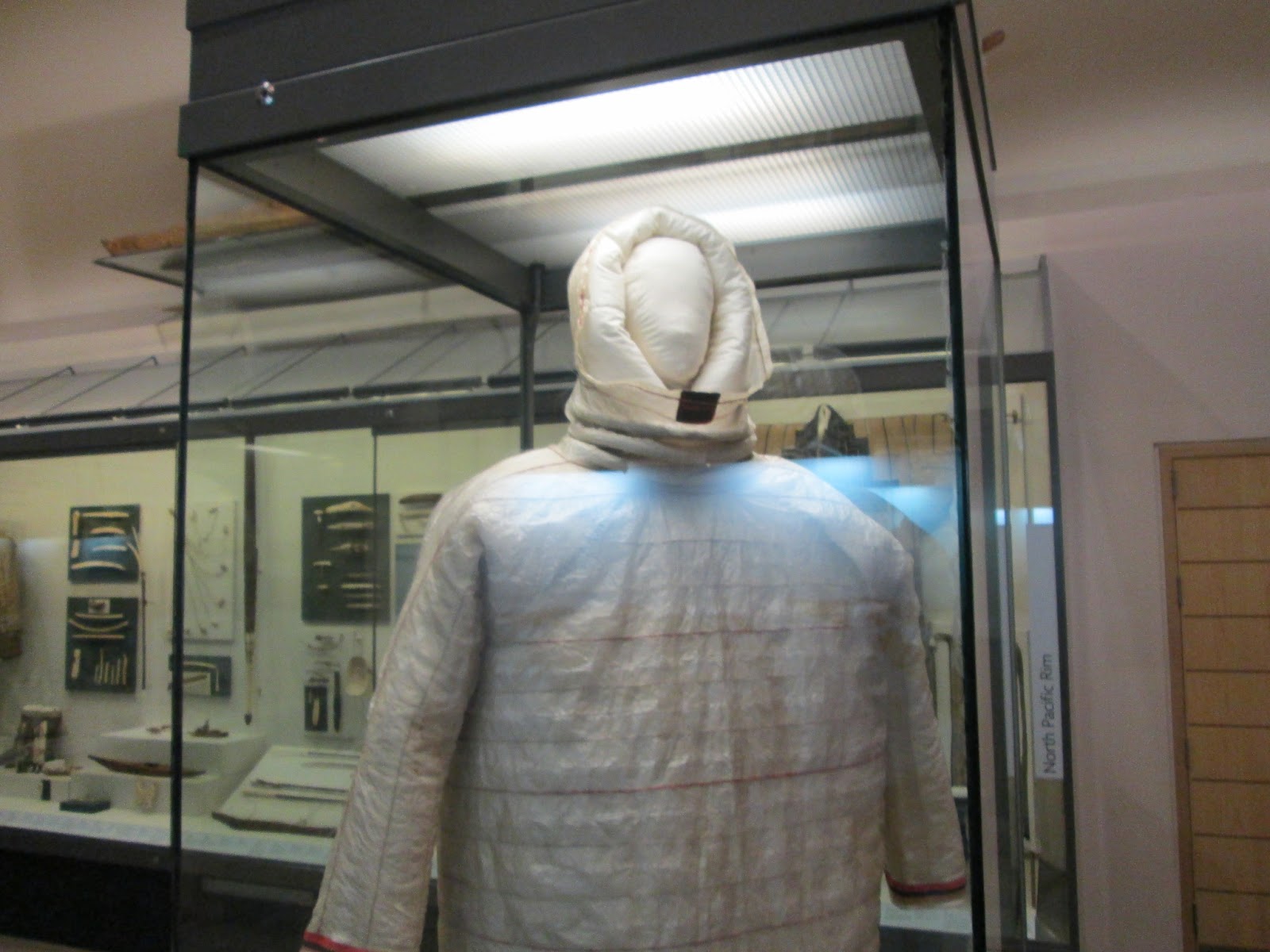
And an example of an Inuit Parka...

In addition, we also have a stuffed bison from the American plains...
 There were also sections of the Museum that had exhibits dealing with the history of Exeter as well as a very nice art gallery. Unfortunately, I found out that you couldn't take pictures in those sections, so I don't have any to show, but I definitely recommend checking those sections out as well.
Now, I feel that I should acknowledge that  a lot of these items might have been acquired via force or plundering during the expansion of the Empire, but its also possible that many were acquired via legitimate trade (or in the Bison's case, simply firing a gun out the window of the train). Ultimately, the items, like the artifacts and exhibits in any good museum, tell a story and educate people, whether they be young children or American college students. Another great part about the Museum? It's free. So, if any of you happen to be in Exeter and have an hour to two to spare, I definitely recommend giving this place a look.


Saturday, March 2, 2013

Game of Totnes

(Hi everybody. Terribly sorry for the lack of new posts these past few weeks. Schoolwork and a pretty bad fever kept me on the defensive for a time. However now I'm back, and I have more adventures to share)

As you may recall, I mentioned in my first blog post that England's history was far from peaceful. Indeed, in the 11th century, all manner of men competed for the English crown. Viking, Anglo-Saxon, and Norman kings all battled for control of the Iron Thro... wait, that's Game of Thrones, but the situation in medieval England wasn't that different. Case in point, my flat visited the town of Totnes today and observed this Norman Castle.


 While fairly simple compared to later medieval castles, this example of a motte and bailey defense is perched high atop the hill, overlooking the entire town. Built soon after the Norman conquest, the castle was meant to both defend the city and keep the Saxon subjects in line.

Taking the long walk up from the train station towards the castle it was not hard to imagine the difficulty that enemy forces would have faced trying to reach the fortification.


While they were marching, both soldiers and subjects would have watched their approach from behind the walls...
At the time of battle, the men would have rushed from the inner circle...
Up to the battlements...


From there they would have had an excellent view of the city...


Arrow slits would have provided protection for archers...
Commanders would have barked orders to their men...
Incredibly handsome men would have posed at the wall, knowing that they were too awesome to be killed...


Jon Snow would have waited at the top of the fort, not even able to comprehend the sheer terror that awaited him once winter finally arrived...

.... dang it, I need to stop watching Game of Thrones  when I write these posts. At any rate, the castle was very cool, and while William the Conqueror might not have had to deal with Starks, Lannisters, and Greyjoys,  a castle like this one would have been a great help, nonetheless, against the many real dangers to his crown.

In addition to the castle, the town of Totnes has much to offer. Today, the town no longer plays host to the struggle between kings, but rather is known throughout England as a gathering place of Artists, Musicians, and Bohemians. The city is mostly peaceful, and plays host to an excellent marketplace.

It's the type of town where artists can sell their works in homes built in medieval times...


 It's also the type of town in which men can have owls as pets, thereby fulfilling the dreams of every single person who has every read Harry Potter...

Training an owl must've been a real hoot (sorry).

The town itself is very medieval in style and the restruant where we ate had excellent fish and chips.


Also, I felt I had to mention, for all you Shakespeare fans, you might remember this quote from Hamlet.

HAMLET

    Well, God-a-mercy.

LORD POLONIUS

    Do you know me, my lord?

HAMLET

    Excellent well; you are a fishmonger.

LORD POLONIUS

    Not I, my lord.

HAMLET

    Then I would you were so honest a man.

LORD POLONIUS

    Honest, my lord!

HAMLET

    Ay, sir; to be honest, as this world goes, is to be
    one man picked out of ten thousand. 


Well, it is my great pleasure to report that while Hamlet was using fishmonger as slang for pimp, actual fishmongers who sell fish still exist in England...
 

 Totnes is an interesting city. The city has its own currency and its considered a transition town, as it is committed to being prepared for the effects of global warming and peak oil. While I'm not sure that setting up one's own currency will stop global warming, the town's status as a 'transition town' combined with its focus on bohemian lifestyles is quite interesting (not to say that every thing was perfect, we witnessed quite the argument between two residents over issues of begging, standing, and fighting).

In the end, Totnes, in addition providing excellent history and culture, also provided us with the first hints of spring.


These flowers, the first I've seen in a while are a welcome reminder of the color and life that each spring brings and I'm excited for spring in England (hopefully this means the Sun will be out a little more than it has been).

 
And finally, just for fun...

Here is a store called Susie and Me.

 And here is the store across the street, Stolen from Susie.


Here's a picture I took of Tom taking a picture of Tessa, who's taking a picture of Sarah... Picturception?